Computational Architecture: A New Spatial Paradigm
The Transition from Manual to Generative

For several decades, the architectural profession has relied heavily upon software solutions that merely digitize the traditional manual drafting process without fundamentally altering its underlying mechanics. We transitioned from physical tracing paper to digital screens while preserving a workflow where a designer must still draw individual lines to represent a wall and painstakingly construct groups of vectors to represent a door. This established method does not represent true computational design; rather, it is simply manual drafting performed on a computer screen. The profound shift in this paradigm only occurs when we cease drawing explicit boundaries and begin defining the spatial logic of a building, allowing a system to resolve those abstract constraints into precise and viable geometries.
Natural Language as the Interface
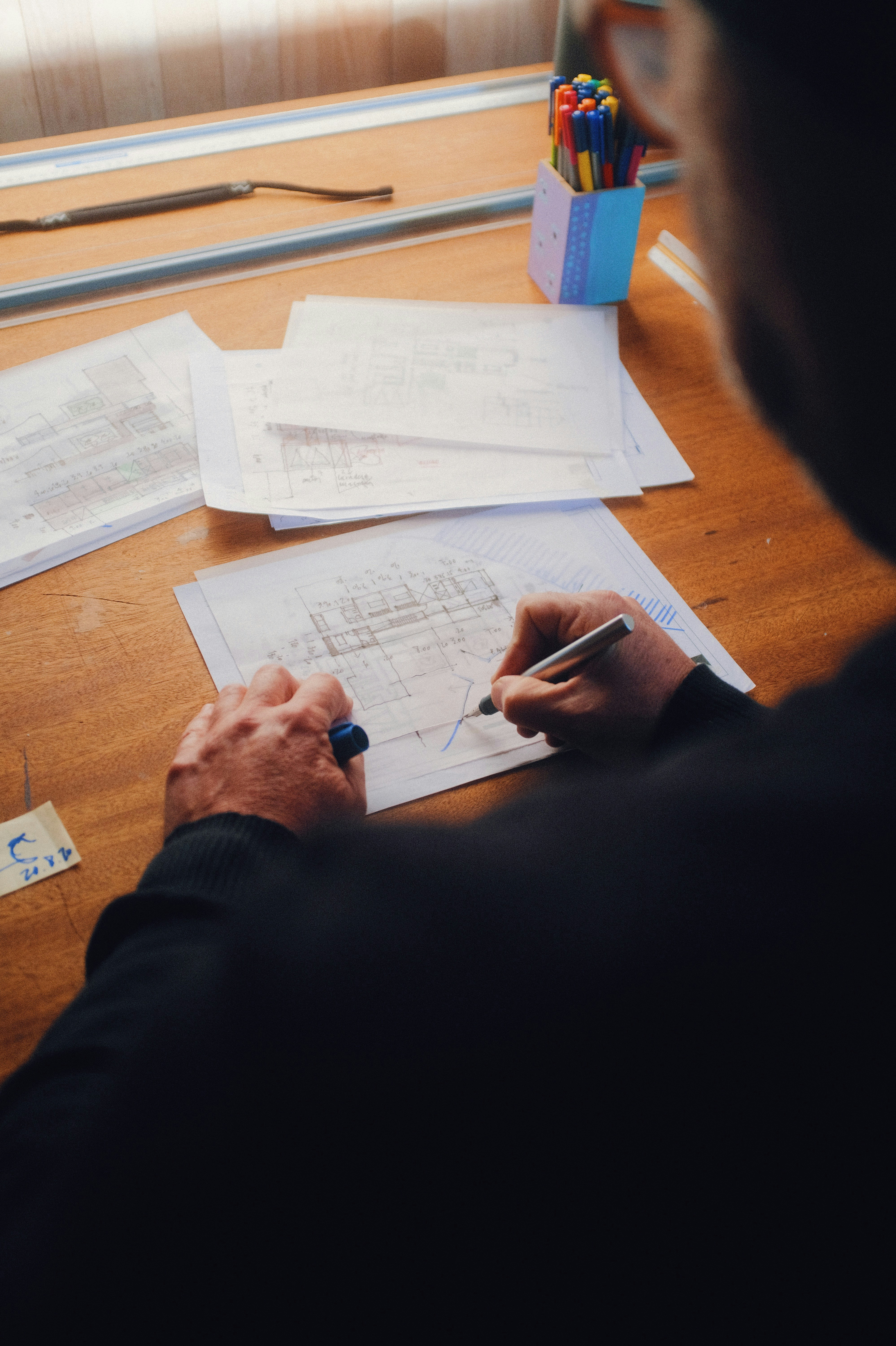
We firmly believe that the highest-fidelity interface for human creativity has always been natural language. An architect naturally conceives and describes a space in terms of its experiential qualities like flow, natural light, proportional harmony, and practical utility, making the subsequent translation of those rich concepts into rigid X and Y coordinates a massive and unnecessary source of friction. By building an intelligent engine that natively understands and processes natural language descriptions, we can bypass the tedious drafting phase entirely. The machine takes on the responsibility of translating the designer's intent into concrete geometry, which allows the human architect to focus entirely on refining the intent itself.
Systems and Scalability
Our backend orchestration relies upon multiple deterministic engines working in seamless concert with advanced generative models to ensure that our outputs are rigorously accurate. We explicitly do not use artificial intelligence to blindly generate or guess at floorplans; instead, we utilize these models to parse the nuanced semantic meaning of your prompt, which is then fed directly into strict, rule-based computational geometry systems that mathematically guarantee architectural validity. This carefully structured hybrid approach ensures that every exported CAD file is impeccably clean, meticulously layered, and immediately ready for rigorous engineering review. Our systems guarantee that there are no overlapping vectors and no structurally impossible cantilevers, leaving only clean and precise logic that respects the laws of physics and construction.
The Horizon
The generation of floorplans serves merely as the entry point into a much broader and more ambitious vision for the future of spatial design. Our eventual goal is the development of a unified platform where natural language can fluidly orchestrate entire architectural systems, seamlessly integrating everything from complex HVAC routing to intricate structural load distribution. The computational tools and frameworks we are actively building today serve to lay the essential foundation for that fully integrated and deeply collaborative future.